-
 By HOM Social
- October 10, 2026
- 0 Comments
- CREATOR ECONOMY
Today is the 25th anniversary of 9/11. There is no greater city than New York and nobody rallies together harder in the darkest moments.
Notes: Next week’s conference roster is stacked: IAB CreatorFronts 9/15 | BrandWeek 9/15-9/17 | Pinterest Presents 9/17 | HubSpot Unbound 9/16-9/18 | Scroll Forward 9/18
Plus, we’re continuing to see creators hired for active consultancy roles: Cat Goetze, aka CatGPT, is joining Smooth Media as its first external stakeholder and Creator Advisor; Dhar Mann is Advertising Week’s Chief Creator Officer hoping to spark $100M in new creator-brand business at the summit; and I’ll get a chance to talk to Jordan Howlett, aka Jordan the Stallion, about his new role as Chief Content Officer for Blender Eyewear when we’re on a panel together at CreatorIQ Connect next month.
-
Instagram now lets you add posts you’re tagged in to your profile grid
-
Poll: Will you use Muse, the new personal agent Meta launched this week?
-
YouTube released a new Culture & Trends report: In Search of Mainstream — worth a read!
-
Pinterest searches conducted by Gen Z men have increased 17% year over year
-
Substack added a dedicated tab for podcasts
-
IMDb entertainment database is adding “Digital Creator” as a new professional category
-
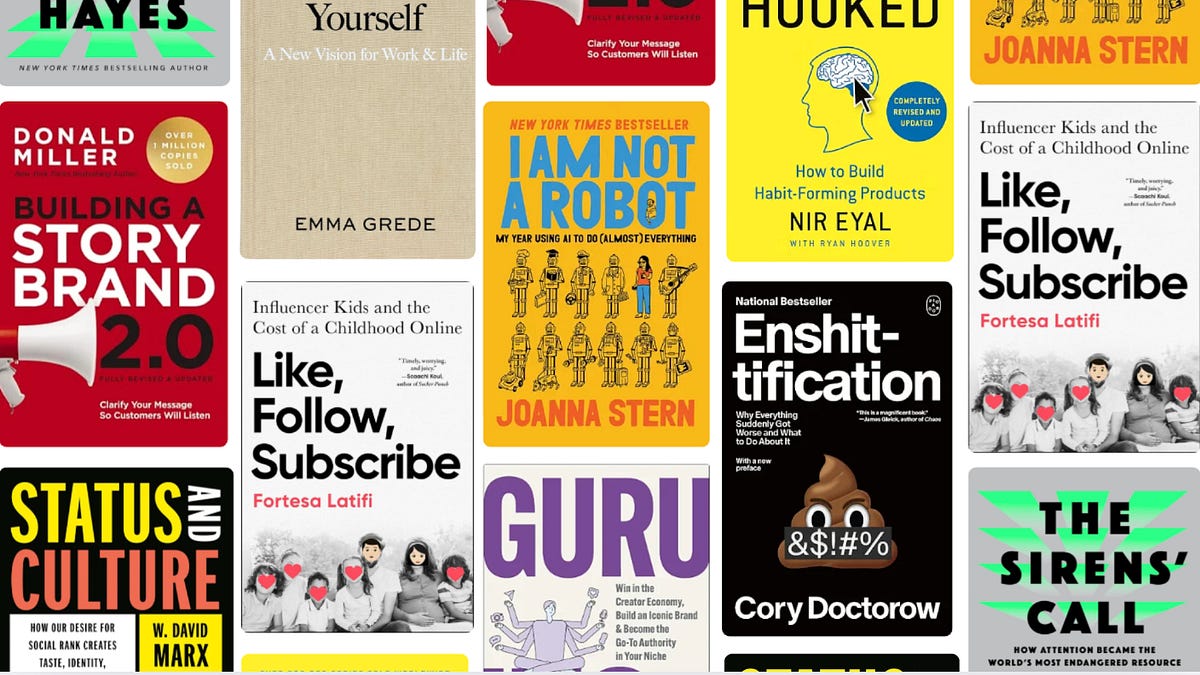
The Best Books for Marketers: the business, personal growth and cultural books inspiring the ICYMI community
-
And so much more…
-
Instagram now lets you add posts you’re tagged in to your profile grid. In case you’re called on to clarify the difference between a Collab post and a Tagged post, Meta told me the main difference is that a collab post is shared by multiple authors — that means the post will show up to their combined audiences, and all collaborators can see how the post performs. With tagged posts, the content still belongs solely to the author that originally posted it. It’s a curation tool, versus a distribution tool, that let’s you spotlight those photos that a friend or creator has tagged you in.
-
Meta launched Muse, an AI agent meant to handle your personal tasks. It’s free for basic use (you get up to 100 million tokens per week for free — the limit resets weekly). There are two paid tiers: Power at $20/month and Maximum at $100/month. Both give you more Muse usage. The success of Muse — as I see it — is tied to people trusting the app enough to give it access to their entire digital lives: email, calendar, payments, health, shopping and smart home apps. Will you use it?
-
Threads Insights leveled up this week, letting you see post performance, new metrics like profile visits, and better understand how your content is reaching followers versus non-followers.
-
YouTube released a Culture & Trends report with NRG: In Search of Mainstream. It’s very much worth reading. Two of the things that stood out to me: Reaching everyone all at once is harder, but mainstream culture still exists: 63% of 14- to 29-year-olds agree that being into the same things as other people makes them feel part of something bigger. And success is a collective achievement: 63% of fans agree with the statement, “I feel successful when the person or thing I’m a fan of experiences success.” Online communities determine what gains momentum, gets shared, and, ultimately, breaks through.
-
YouTube shared a new Nielsen report that showed YouTube maintains its spot as the #1 U.S. TV and streaming distributor.
-
YouTube announced it’s updating the platform’s “paid promotion” terminology to align with the industry standard “branded content.”
-
TikTok is returning as the Official Platform Partner at the 2026 Toronto International Film Festival (TIFF) bringing together creators, filmmakers and industry leaders.
-
Snapchat launched Snapchat Plans — a dedicated place to create, share, and manage plans with friends. Snapchatters can create and personalize an event invite, choose a date and time, and invite up to 200 friends. Invitations are delivered via chat where guests can go to RSVP.
-
Snap’s Evan Spiegel released a memo he sent to staff about the future of Snapchat. Areas he’s focusing on include SPECS (personal computing), tools to support creators and turning Snapchat into a shopping channel.
-
Pinterest released its 2026 Men’s Report, revealing that Gen Z men are searching Pinterest more than ever (+17% year over year) and they now account for more than 62%2 of male monthly searches.
-
Pinterest published a blog post on the benefits of visual discovery, suggesting it helps create new demand rather than only catching people who were already searching.
-
Substack launched a new Podcast Tab in its iOS and Android apps. Similar to the Read tab, creators will be able to reach their existing listeners and be discovered by new listeners.
-
LinkedIn has launched a couple of curated community programs — Next Gen and Entertainment. The invite-only groups offer networking opportunities, best practice resources, a weekly newsletter and in-person sessions, signaling a renewed platform focus on creators.
This newsletter community is full of smart people, so when I asked if anyone wanted to do book reviews for the third Best Books for Marketers list, I knew the recommendations would be good.
No surprise: you’ll probably want to add at least one of these to your cart.
And they’re not all marketing books — reviews run the gamut from strategy and AI to pop culture:
-
I Am Not a Robot: My Year Using AI to Do (Almost) Everything
-
Like, Follow, Subscribe: Influencer Kids and the Cost of a Childhood Online
-
The Sirens’ Call: How Attention Became the World’s Most Endangered Resource
-
Enshittification: Why Everything Suddenly Got Worse and What to Do About It
-
Building a StoryBrand 2.0: Clarify Your Message So Customers Will Listen
If you’ve been looking for advice, insights and inspiration, consider this your Fall reading list. Alternately, if you’ve got a suggestion, please leave it below!
Hooked: How to Build Habit-Forming Products, by Nir Eyal
Cristina Lopez, Community + Content Strategist:
This book really educates you on understanding behaviors and how they affect everything from purchase, use, and, intent. I loved learning about the psychology of hooks and at the core this book captures that it’s not really about what we want, but what consumers want. Fail to do that and you lose them. Definitely worth a reread.
Best for: anyone starting a business, social media strategists, and creators
I Am Not a Robot: My Year Using AI to Do (Almost) Everything, by Joanna Stern
Johanna Voss, COO for Talent Management Agencies:
“Trust is shaky.” Those 3 words stuck with me. AI can be incredibly useful and make life easier. And also there’s still something unsettling about relying on a tool that can be so confident and capable while also being so wrong. The book made me think about that tension: how quickly we’re willing to hand over decisions because something is convenient, even when we know we shouldn’t blindly trust it.
Best for: someone who is AI-curious, uses maybe ChatGPT or Claude(tte) but still gives AI the side eye and isn’t exactly sold or sure on all that it can (and can’t) do.
Guru Inc: Win in the Creator Economy, Build an Iconic Brand, and Become the Go-To Authority in Your Niche, by AJ Kumar
Libby Gluck, Brand Strategist:
Guru, Inc is a mix of memoir, practical guide, and self-help book. Kumar excels at breaking down the nuances of becoming a public figure on social media, and how to maintain an authentic presence. The book is filled with accessible and actionable advice that creators will find valuable. However for marketing professionals looking for more strategy and less memoir, this book may not be for you. For creators who want to be the Mel Robbins, it’s a great resource.
Best for: creators who are interested in becoming the next Mel Robbins or Jay Shetty
“In a country where economic stability feels so precarious and increasingly unreachable for all but the wealthiest among us, is it any wonder Americans are taking their turn playing the viral lottery?”
Like, Follow, Subscribe: Influencer Kids and the Cost of a Childhood Online, by Fortesa Latifi
Vincent Orleck, Founder Not a Guru Marketing:
I’ve worked in social media long enough to watch it completely reshape how we share our lives. I’ve also raised a Gen Z daughter and am now raising a Gen Alpha one, which made Like, Follow, Subscribe especially uncomfortable and important. Latifi examines what happens when childhood becomes content, and privacy, consent and even family relationships become part of the business model. What stuck with me most is that a parent’s right to share isn’t necessarily a child’s choice to be shared. The internet remembers long after childhood ends.
Best for: parents, marketers and creators, but especially anyone who has ever posted a child online and thought, “What’s the harm?”
The Sirens’ Call: How Attention Became the World’s Most Endangered Resource, by Chris Hayes
Mason Stark-Nichols, Creative Strategist:
I liked Hayes’ perspective as a news anchor because he’s writing about an attention economy he’s also part of. The distinction that stuck with me most is between attention we choose to give and attention that gets pulled from us by whatever is loudest, newest, or most emotional. The book doesn’t offer many practical solutions for what to do once you recognize this dynamic, but I think that’s okay. I found the way he describes the problem more interesting and thought provoking than a prescriptive answer would have been.
Best for: marketers, strategist, anyone partaking in the attention economy
“This era, the Enshittocene, is the result of specific policy decisions, made by named individuals. Once we identify those decisions and those individuals, we can act. We can reverse the decisions.”
Enshittification: Why Everything Suddenly Got Worse and What to Do About It, by Cory Doctorow
Anna Abraham, Culture + Content Strategist:
Cory Doctorow’s Enshittification captures the familiar and hauntingly inescapable end point of the 2020s internet, wherein tech behemoths lure in willing (yet unsuspecting) consumer audiences, sell them out to partners and advertisers, and then bleed both dry in service of their ticker price. Peppered with his caustically Canadian charm, Doctorow outlines the shape of the problem and offers up a beginner’s primer to tech regulatory policy that may guide us to an internet built in service of the *checks notes* proletariat. Lofty goals, indeed. Come for the shit puns, stay for the inevitable radicalization.
Best for: strategists, marketers, and honestly anyone who’s on the internet in 2026
Status and Culture: How Our Desire for Social Rank Creates Taste, Identity, Art, Fashion, and Constant Change, by W. David Marx
Kaley Mullin, Co-Founder of Cool Shiny Insights:
I want all market researchers and people interested in how culture functions to read this book. For me, it was the perfect mix of breezy pop culture anecdotes and rigorous academic grounding. It validates what Cool Shiny Insights has always asserted: that cultural shifts are not unpredictable and random, but are driven by fundamental human behavior and how we interact with one another in society.
Best for: marketers, market researchers, anyone interested in culture and trends insights
“Placing stones in the creek greatly increases the chance the customer will cross the creek.”
Building a StoryBrand 2.0: Clarify Your Message So Customers Will Listen, by Donald Miller
Megan Hansen, Customer + Content Marketing Strategist:
This book is such a good reminder to hero your customer. It’s not about you. It’s about them. Good, customer-first marketing makes people feel seen, not talked at while you list everything you do. In an age of so much noise, that’s a refresher worth having. Miller walks you through a 7-step framework for building your brand’s story. A lot of it isn’t new, but it’s focused and full of good reminders. I liked the idea of “stop forcing clients to burn calories thinking,” and the point that “the three things every human being wants most are to be seen, heard and understood.” If you’ve never thought about marketing this way, or the internal grind has taken you off-course, it’s a great read. Most examples skew small-business rather than large companies, but the ingredients are the same: make customers feel seen, alleviate confusion, simplify their journey, build trust through empathy, and you’ve got it.
Best for: marketers, small-business owners, solopreneurs who need a good guide on customer-first marketing or are in want of a good refresher!
Start With Yourself – A New Vision for Work and Life, by Emma Grede
Lia Haberman, ICYMI Founder:
I’ve seen Emma speak twice so I went into this with a bias: I really love what she has to say. This book confirmed my beliefs. She’s so bluntly unapologetic and doesn’t believe in mindless pleasantries or avoiding tough conversations. In fact, LA and its manifestation culture, where people “operate under the delusion” that things should just happen for them, gets a literary side-eye in the book. There are no shortcuts or magical playbooks for women, says Emma, you get to the top by working hard. The book is part career history — she had very humble beginnings — but it’s also part therapy session that encourages a mindset shift in discarding limiting beliefs and clarifying your (ambitious) thoughts.
Best for: women — working women, non working women, stay at home moms, working moms, single women, married women — who want more
*book list includes Bookshop.org affiliate links
-
Apple released the new iPhone 18 and the Duo foldable phone — there were memes – CNET
-
Amid growing AI distrust, humanity takes a front seat in advertising – Marketing Brew
-
The employee influencer trend raises new legal risks for companies – Bloomberg Law
-
Brands are pushing influencers to hide their paid deals – Business Insider
-
Wimbledon is banning influencers, sparking a debate about social media etiquette at major sporting events – The Independent
-
For the first time ever, IMDb is adding “Digital Creator” as a new professional category – Variety
-
The fastest growing brands with TikTok users (was not expecting to see Norwegian Cruise Line on there) – Morning Consult
Thanks for reading! If you got all the way down here, can you let me know what you think is the most compelling topic for a subject line? (Clearly if you’re here, books worked but what do you think has the most mass appeal?)


